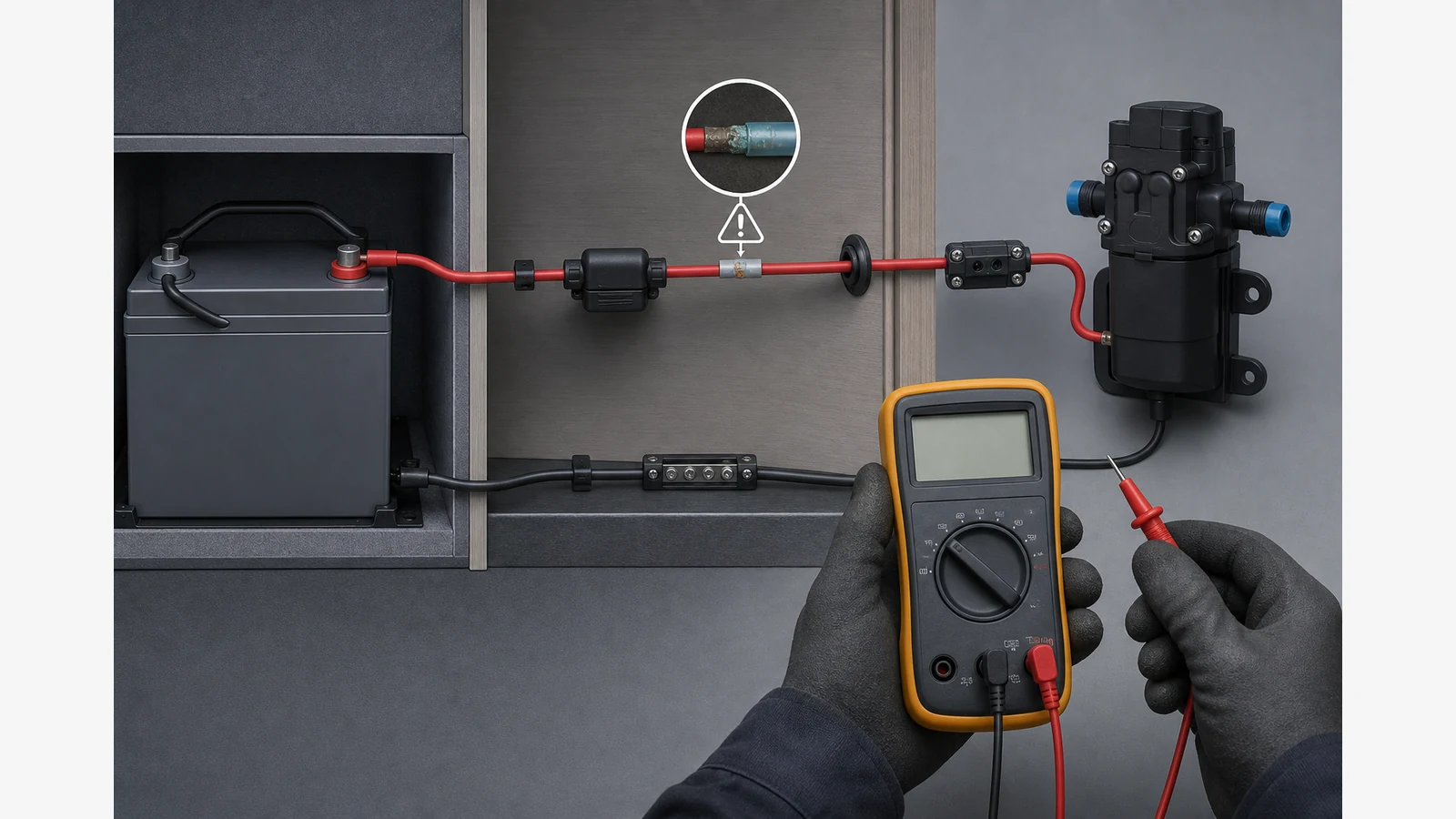
Low Voltage Symptoms In A Leisure Water Pump System
Low or unstable voltage under load can make a 12V water pump look weak, slow or intermittent — but it is only one branch of diagnosis. Manufacturer troubleshooting lists low voltage alongside wiring checks for hard starting, poor performance and related symptoms, while plumbing faults (strainer, air, valves) can look similar at the tap. Resting battery voltage alone is not the same as voltage while the pump is trying to run.
Do not bypass fuses, probe live circuits beyond your competence, or work beside LPG equipment with improvised jump leads. A leisure battery can supply enough current to overheat undersized or damaged cable. Seek a qualified caravan electrician when heat, smell or uncertainty appears.
Symptom table
| Symptom | Voltage branch to consider | Also rule out |
|---|---|---|
| Slow flow or sluggish start | Discharged battery; long thin cable run; poor joints | Part-blocked strainer; kinked hose; air |
| Pump fails to start but lights still work | Voltage collapse under load; high-resistance connection | Failed switch; open fuse; seized pump |
| Intermittent operation over bumps | Loose or corroded connector | Intermittent earth; damaged conductor |
| Cycling or odd cut-outs | Unstable supply into the pump controls | Pressure leak; air ingress |
| Warm plugs or discoloured cable | Resistance heating — isolate immediately | N/A — escalate |
Owner-level checks without defeating protection
- Confirm the leisure battery state of charge with your normal battery monitor or a competent helper.
- Inspect visible cable for crush damage and green/white corrosion on connectors.
- Reseat plugs only after isolation if they are designed to be disconnected.
- Verify the correct fuse is present and not intermittently open — never upsize it.
- Note whether symptoms worsen when other 12V loads run at the same time.
Why “12.something volts on the meter” can still be wrong
A meter reading on a resting battery does not show what arrives at the pump while the motor draws current. Voltage drop along corroded connectors or an underspecified cable run appears under load. Exact acceptable figures and cable sizes must come from the vehicle wiring design and the pump label — this article will not invent them.
Technician-level follow-up
Competent technicians may compare loaded voltage at the battery and at the pump, verify earth integrity, and inspect shared distribution points. Club 12-volt wiring guidance stresses suitable overcurrent protection and professional help when installation or repair is uncertain. Manufacturer manuals similarly expect protected circuits and label-matched fusing.
Do not stop at the electrical story
If voltage looks healthy under load, return to plumbing diagnostics: no-flow ladder, strainer cleaning and cycling checks. Low flow does not automatically mean low voltage.
If the supply is proven and the pump has failed, compare a replacement 24 V DC diaphragm pump only as a final step: SURGEFLO FL-44 24V DC pump details.
FAQ
Can a low battery blow fuses?
Low voltage and high current faults are different issues. Repeated fuse failure needs isolation and diagnosis — not a larger fuse.
Should I thicken the cable myself?
Only as part of a proper redesign by someone competent, matching protection devices to the new cable. Random thicker cable without correct fusing is not a safe DIY patch.
Is solar charging a cure for pump symptoms?
Charging helps a depleted battery, but it will not fix a corroded connector or a blocked strainer.