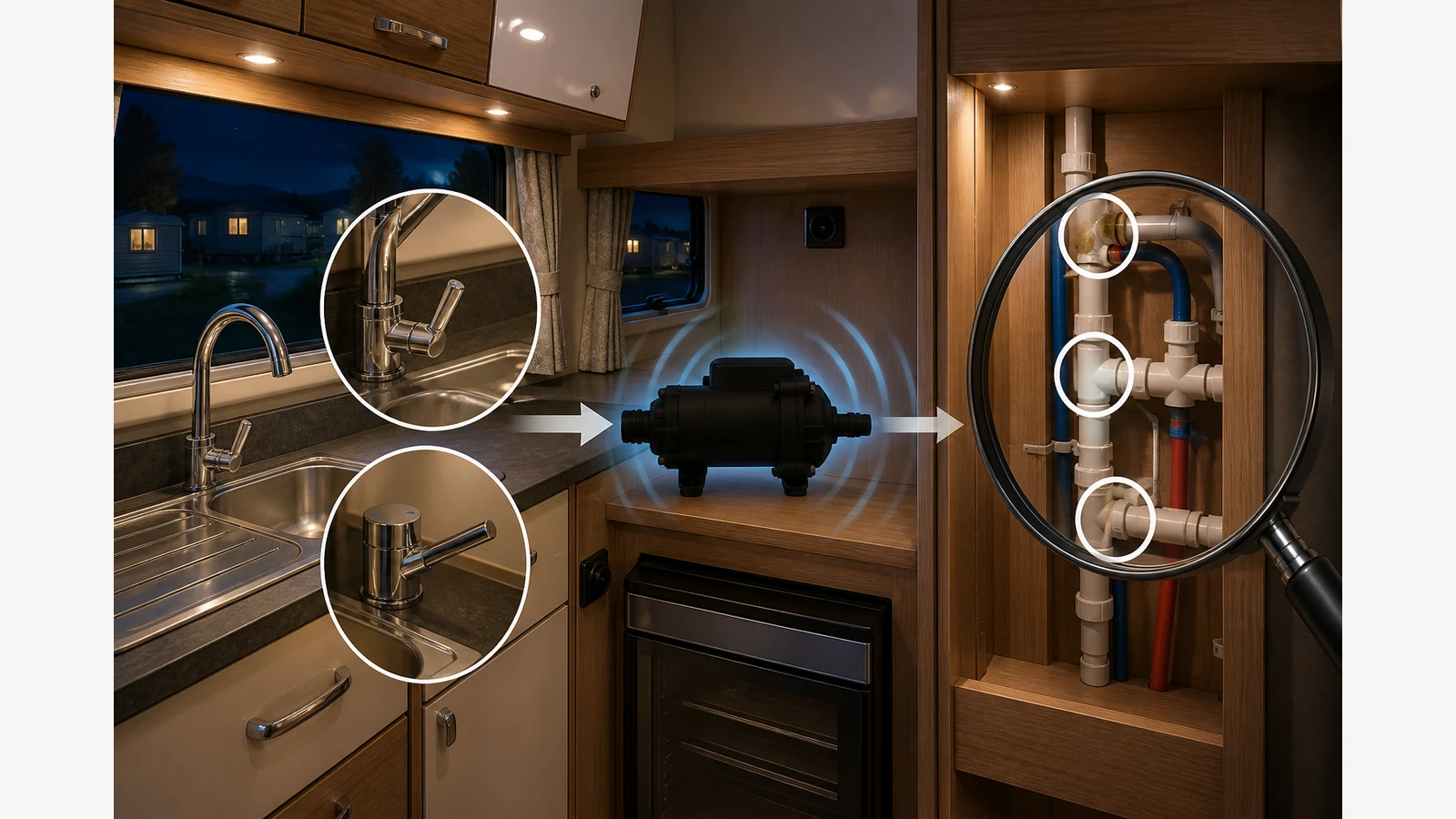
Caravan Water Pump Keeps Cycling with Taps Closed: What to Check First
If a caravan water pump keeps starting and stopping while every tap is closed, treat it as a pressure-loss or control symptom — not as normal overnight behaviour. Isolate the pump when you leave the van, then look for visible leaks, trapped air, inlet restrictions and valve issues before anyone touches a pressure switch. Manufacturer troubleshooting lists rapid cycling among faults linked to air leaks, restrictions, valves, fittings and low voltage.
Do not leave repeated cycling unattended. It can waste water, flatten a leisure battery, or point to a leak inside a locker. Switch the pump off when away from the vehicle, as Caravan and Motorhome Club freshwater guidance advises.
Short run-on versus repeated cycling
| Observation | Likely meaning | First action |
|---|---|---|
| Pump runs briefly after closing a tap, then stays off | Often normal pressure catch-up on some systems | Confirm it stays off for a long quiet period |
| Pump restarts every few seconds or minutes with all outlets closed | Pressure is dropping or the control is hunting | Isolate, inspect for leaks/air/restrictions |
| Pump never shuts off | Open path, major leak, or control fault | Switch off immediately and escalate |
1. Isolate and do a dry visual pass
Close all taps, including the shower and any external shower point. Switch the pump off, then check for damp patches under the sink, around the water heater connections, toilet flush valve area, and accessible pressure-side joints. Wipe joints dry and watch whether moisture returns when you briefly restore power for a supervised test.
2. Check outlets that can “look closed” but still leak pressure
- Mixer taps that do not shut fully
- Toilet valve weep
- Heater drain or pressure-relief related seepage (follow the heater maker’s advice; do not force relief valves)
- Quick-connect fittings that have crept loose after travel
3. Inlet strainer, air ingress and supply health
Air on the suction side and blocked strainers are standard items on diaphragm-pump fault maps for cycling and unstable pressure. Inspect any serviceable inlet strainer and inlet hose seals. After storage or refill, clear air locks using the vehicle method rather than repeated unattended cycling.
Also consider supply voltage: low voltage appears in manufacturer symptom lists alongside rapid cycling. If the pump seems weak or intermittent, read the low-voltage symptoms guide before assuming the pump is worn out.
4. Why factory settings and model-specific designs matter
Some pumps include bypass or accumulator arrangements described only in the model manual. A procedure written for one branded RV pump is not automatically safe or correct for another unit. Do not adjust a pressure switch, add an accumulator, or claim a particular shut-off pressure will fix the fault unless your exact manuals support that step.
When to switch off and book service
- Cycling continues after leak, air and strainer checks
- You find heat, burnt smells or fuse issues on the pump circuit
- Water is appearing where it should not, especially near electrics
- You would need to open the pump or alter switch settings to continue
If diagnosis shows the pump itself is finished and you need a 24 V DC diaphragm pump for a leisure freshwater system, compare options only after the system leaks and wiring are understood: SURGEFLO FL-44 24V DC pump details.
FAQ
Is occasional night-time starting always a leak?
Not always — temperature changes and trapped air can play a part — but repeated cycling with closed taps deserves a leak and air check, and the pump should be off when the van is unattended.
Will a bigger fuse stop cycling?
No. Cycling is a pressure/control symptom. Never upsize a fuse to mask a fault.
Should I fit an accumulator straight away?
Only if your vehicle and pump documentation support it for your symptoms. It is not a substitute for finding a leak.