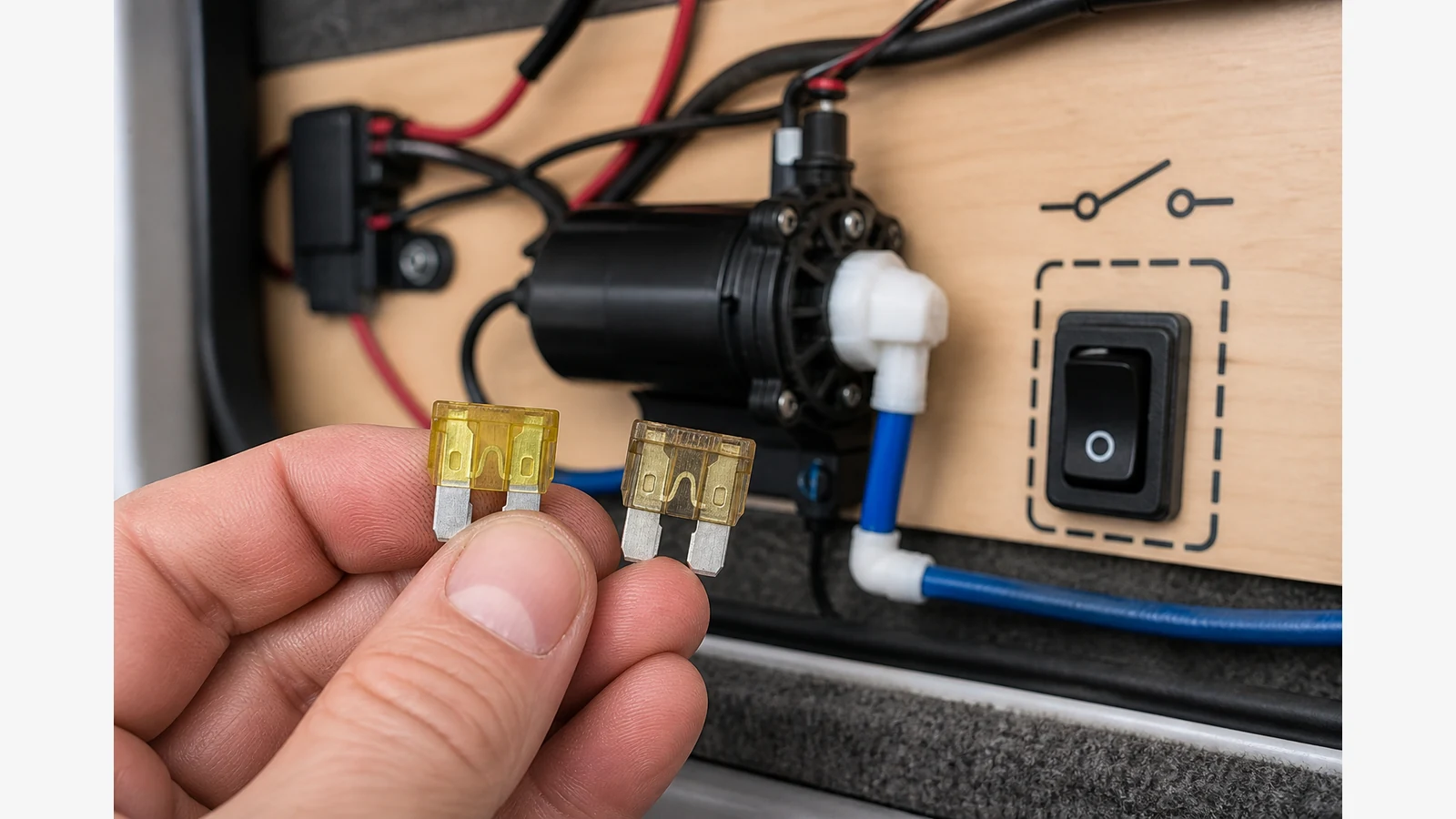
Caravan Water Pump Fuse Keeps Blowing: Do Not Fit a Bigger Fuse
If a caravan water pump fuse keeps blowing, isolate the circuit and find the cause. Do not fit a higher-rated fuse, foil a holder, or bridge the protection “just to finish the trip”. The fuse protects the cable as well as the pump; a leisure battery can deliver enough current to overheat wiring if that protection is defeated.
Isolate power first if you smell burning, see discoloured insulation, find moisture in connectors, or the pump housing is abnormally hot. Arrange a qualified caravan electrician when repairs or diagnosis are beyond a visual check.
Why the fuse rating is not a DIY upgrade
Caravan and Motorhome Club 12-volt wiring advice is clear that each circuit needs suitable overcurrent protection and that uncertain electrical work belongs with a qualified engineer. Manufacturer installation practice for leisure diaphragm pumps likewise expects a protected individual circuit and a fuse matched to the label and wiring design — not an improvised higher rating.
Visual checks you can do after isolation
- Confirm you are looking at the correct pump circuit fuse and that the replacement type matches the original style.
- Inspect accessible cable for crushing, chafing through bulkheads, and green or white corrosion in connectors.
- Check for water ingress around the pump and switch gear.
- Note whether the pump smells hot, turns stiffly by hand only if the maker allows that check, or shows signs of a seized motor — stop if unsure.
- Look for loose crimps that spark or heat under load (observe only; do not probe live conductors unless competent).
Match any replacement fuse to the design — never “one size up”
If a single fuse failed after an obvious short that you have permanently corrected, a like-for-like replacement may be appropriate. Repeated failure means the fault remains. Fitting a larger fuse to stop blow-outs can leave the cable unprotected.
Do not publish or guess an amperage for a pump whose label you cannot read. Use the vehicle wiring information and the pump’s own rating plate when available.
Checks reserved for a competent technician
- Loaded voltage at the pump while it tries to start
- Short-circuit isolation along the cable run
- Motor current behaviour and internal faults
- Shared-circuit interactions with other 12V loads
Manufacturer troubleshooting also links hard-starting and related electrical symptoms to low voltage and wiring faults, so a fuse that blows only under load may be a cable, connection or motor problem rather than “a weak fuse”.
Related symptoms worth reading next
If the pump runs but delivers nothing, clear supply and air faults before assuming an electrical failure. If voltage sag is suspected, use the low-voltage symptoms guide. Neither article replaces safe isolation when fuses are failing repeatedly.
After the circuit is proven safe, and only if the pump itself has failed, you may compare a replacement 24 V DC diaphragm pump here: SURGEFLO FL-44 24V DC pump details.
FAQ
Can I wrap a blown fuse in foil to get water tonight?
No. That removes cable protection and is a fire risk.
The pump works for a minute then blows the fuse — is that normal?
No. That pattern suggests overload, a developing short, mechanical binding or a serious wiring fault. Isolate and diagnose.
Who should rewire a pump circuit?
If you are not competent with 12V leisure electrics, use a qualified caravan electrician or approved workshop.